How to Find Tree Removal Companies Near You (and When Speed Matters)
Most people start the same way: a search for tree removal companies, a page of directory listings full of star ratings and "free estimate" banners, and a growing suspicion that they all look identical. They aren’t. Before you call anyone, work out which of two situations you’re in, because it changes how hard you need to vet.
If the tree is dead, leaning or simply too big for the lot, you have time. Collect two or three written estimates, compare the scope of work line by line, and check credentials before you sign anything. Start your shortlist with local companies that publish their service area, show real project photos and let you read reviews from neighbors. Our guide on how to vet local tree trimming pros walks through the process step by step.
If a limb is on your roof, a trunk is blocking the driveway or a tree is hanging over a power line, speed matters, and so does caution. Storm weather brings out door-to-door crews who show up unannounced, ask for cash up front and vanish. A legitimate company will answer the phone, explain how it will secure the site, and give you a clear scope of work even in an emergency. Call a company you can verify, and keep the vetting steps below short but don’t skip them. If the situation is truly dangerous, like a tree on a structure or against energized lines, get everyone clear and treat it as an emergency first and a purchasing decision second.
Locally, storm damage tree removal in Blaine and Coon Rapids and emergency tree services are the pages to read before the next windstorm, so you know what a proper response looks like before you need one.
Minnesota Registration: What a Legit Company Must Have
Minnesota has a simple first filter, and plenty of homeowners never use it. Every tree care and tree trimming company doing business in the state must register with the Minnesota Department of Agriculture, according to the state’s checklist for hiring a tree care company. The requirement covers anyone who provides tree care or trimming, or who removes trees, limbs, branches, brush or shrubs for hire, under Minn. Stat. Chapter 18G.07. You can confirm a company’s status on the state’s Tree Care Registry page.
Two points are worth understanding. First, registration is not a professional license. It tells you the state knows the business exists, not that the crew is skilled. Second, registration is only one layer. The state’s checklist also points to a Sales Tax ID, since tree care is a taxable service in Minnesota, proof of workers’ compensation (sole proprietorships are exempt), and a pesticide applicator license if the company applies restricted-use products, such as insecticides for emerald ash borer.
Ask for the registration number up front. A company that bristles at the request, or says it "doesn’t need one," has told you what you need to know. Then check whether your city adds its own rules. Many do. Saint Paul, for example, requires a certificate of insurance and an ISA certified arborist on staff, as described in its tree trimmer license requirements. We couldn’t confirm specific tree-trimmer licensing rules for Blaine or Coon Rapids, so call your city hall before assuming either way, and ask the company what it holds for your address.
Insurance, Certificates and Certified Arborists: What to Verify
Insurance is where a bad hire gets expensive. Tree work means chainsaws, rigging, falling wood and structures within feet of the work zone. Without adequate coverage, you can end up on the hook for property damage or an injured worker. Ask for liability coverage and workers’ compensation, and have the certificate of insurance sent straight from the insurer rather than accepting a photocopy handed over at your door. Confirm the policy is current and that the company named on it is the one showing up at your house.
For a sense of what a city expects, Saint Paul requires general liability coverage of at least $100,000 for bodily injury and at least $100,000 for property damage. Treat that as a floor drawn from one city’s ordinance, not a universal standard, and not a reason to settle for the minimum on a big removal near your house.
Credentials are the other half. An ISA Certified Arborist has passed the International Society of Arboriculture exam after documenting years of tree-work experience, and you can verify any credential by name through ISA’s public lookup. Two cautions. The state is explicit that accreditations such as TCIA Accreditation are not legal or statutory requirements, so these credentials are voluntary signals of quality, not a legal bar. And the certified arborist who writes your estimate may not be the person climbing your tree, so ask who will supervise the crew on the day.
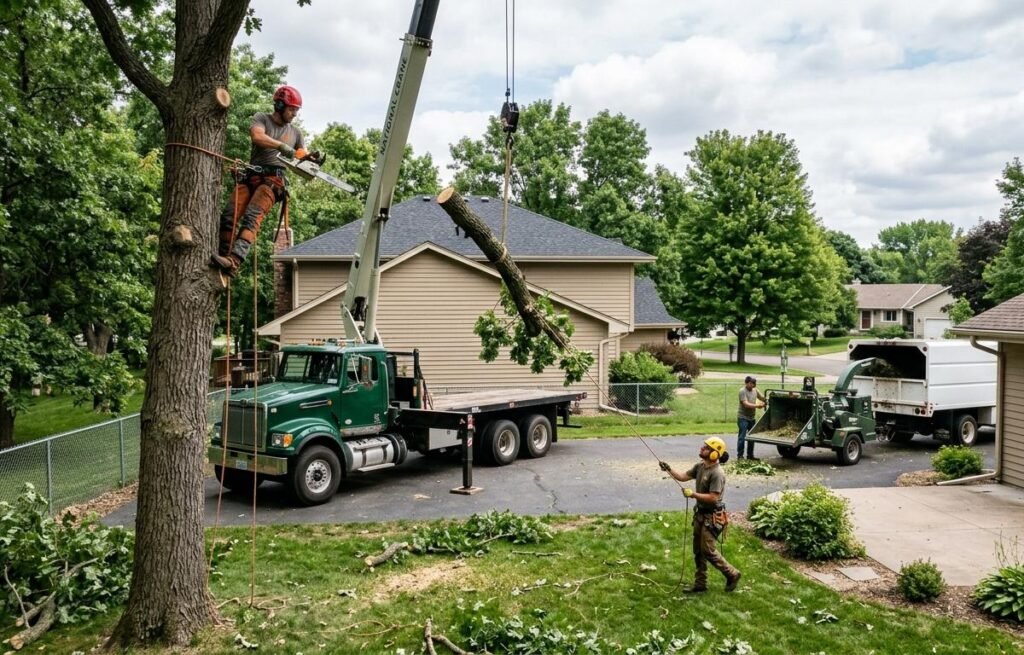
Credentials also help you judge the plan itself. A reputable arborist will explain why a tree should come down or how a cut will affect it, and won’t propose topping, the practice of chopping off a tree’s crown, which ISA standards reject. If someone recommends it, move on. For hard-to-reach trees over structures, ask whether the company offers crane-assisted tree removal, which can reduce risk to your roof, fence and landscaping.
City Rules and Seasonal Timing for Oak and Ash in Blaine and Coon Rapids
Timing is a local issue in the north metro, and it’s one of the best tests of whether a company knows the area. The University of Minnesota Extension reports that the heaviest concentrations of oak wilt in Minnesota are in Sherburne, Anoka, Isanti and northwestern Dakota counties, which puts Blaine and Coon Rapids squarely in the high-risk zone. Extension advises against wounding, pruning or felling oaks in oak wilt-prone counties from April through July, and says any wound made during that window should be treated immediately with paint or shellac.
Coon Rapids has turned that guidance into law. Under the city’s oak wilt control rules, it’s unlawful to prune or trim any oak tree from April 1 to June 30, and owners of an infected tree have 20 days from receiving notice to have it removed. Other local agencies use slightly wider windows, so confirm the dates with your own city. A company that offers to trim your oak in May without mentioning any of this is either unaware or unconcerned, and neither is a good sign.
Ash trees run on a different clock. Anoka County is on the Minnesota Department of Agriculture’s list of emerald ash borer quarantined counties, and the City of Anoka’s utility advises that ash removal should happen during the dormant season, October 1 to May 1. It also warns that putting off removal of an infested ash drives up both cost and danger, because a heavily infested tree turns brittle. The practical lesson: deal with a declining ash early, on your schedule, rather than after a storm drops it for you.
If your property is in one of our service communities, you can see how we handle this on our pages for tree service in Blaine, MN and tree service in Coon Rapids, MN.
Before you hire, ask:
- Are you registered with the Minnesota Department of Agriculture, and what is your number?
- Can your insurer send me a certificate showing liability and workers’ compensation?
- Who supervises the crew, and do you employ an ISA certified arborist?
- Does the estimate cover cleanup, hauling and stump work in writing?
- Do you follow my city’s rules for oak and ash timing?
A company that answers these plainly is worth a closer look. To see our approach and our history in the area, read about Metro Tree & Crane, browse our services, or contact us for a free estimate.