What to Do in the First Hour After a Tree Falls on Your Property
When a storm drops a tree or a heavy limb on your property, the first hour is about protecting people, not saving the yard. If you’re searching for storm damage tree removal near me while the wind is still blowing, work through these steps in order.
Get everyone out of the danger zone first. If a tree is leaning on your house, garage or deck, move your family away from the damaged area. A structure carrying the weight of a tree can shift or collapse further without warning, and storm-bent trunks and limbs can spring loose.
Next, look up and out, but don’t go closer. If any line is touching the tree, hanging low or sparking, treat the whole tree and the ground around it as energized. Power lines are a utility job, not a tree-crew job. Call your utility, and 911 if there’s an immediate hazard, then keep everyone back until the line has been made safe. A tree crew can’t start work near live lines until that happens.
Once the scene is safe, document it before anything gets moved. Take wide and close-up photos and video of the tree, the damage and any affected structure, vehicle or fence. Insurance adjusters generally want photos taken before cleanup begins, along with a written estimate from a licensed tree service, so this step protects you later.
Then call a professional for storm damage tree removal near me, and call before you start any cleanup. Describe what you see: where the tree is resting, whether it’s on the house, whether the driveway is blocked and whether lines are involved. A good dispatcher can tell you if you’re facing a true emergency. A tree pinning a roof or blocking your only way out is urgent. Our emergency tree services crews work around the clock for exactly these calls, and the same goes if you’re in the north metro and need emergency tree service in Blaine or emergency tree service in Coon Rapids.
If the tree fell without touching anything important, it’s less urgent but still worth a call. A tree lying entirely in your yard may be able to wait until daylight, and a crew can stabilize things and schedule the full job properly.
Safety Rules: What Homeowners Should Never Attempt
The most common question after a storm is whether you can remove a damaged tree yourself. For small debris, often branches under about two inches in diameter, many homeowners can safely handle the cleanup with hand tools. Beyond that the risks climb fast, and storm-damaged wood behaves differently from healthy wood.
Never cut wood that’s under tension. Trunks and limbs bent or pinned by the storm store energy, and a single cut can release it violently in a direction you can’t predict. It’s one of the main reasons storm cleanup injures people who’ve run a chainsaw for years on ordinary firewood.
Stay off ladders around damaged trees, and don’t work above chest height. A chainsaw overhead, on a ladder, with unstable branches above you is a combination that sends people to the hospital. Federal safety researchers have long noted that tree removal is among the most hazardous activities during storm recovery, so this isn’t caution for its own sake.
Never touch or approach anything near a power line. Don’t try to push a branch off a line, don’t stand in water near a downed line and don’t assume a line is dead because the power’s out at your house. Wait for the utility.
Don’t climb onto a damaged roof to clear a tree. The roof deck under a fallen tree may be cracked or sagging, and the load on it can change the moment weight is removed or shifted. Lifting a tree off a structure is also where the order of cuts matters most, because one wrong cut can drop the trunk straight through the damage.
Finally, don’t rush to haul everything away before it’s documented. Moving the evidence before the photos are taken can complicate an insurance claim. When in doubt, step back, take pictures and call a licensed, insured crew. If you want to know how to judge who to call, our guide on how to vet local tree trimming pros covers the questions worth asking.
Will Homeowners Insurance Pay for Storm Tree Removal in Minnesota?
This is where homeowners often get caught off guard, because the answer depends on where the tree landed. Coverage varies by policy and carrier, so read your own policy or ask your agent, but some general patterns hold in Minnesota.
When a tree falls entirely on your property without hitting a structure, removal is typically the homeowner’s responsibility. A tree lying in the yard, even a big one, usually doesn’t trigger a claim on its own.
When a tree falls because of a covered peril such as wind, lightning, ice or hail and damages a structure, homeowners insurance typically covers the damage and removal of the tree. A tree through the roof, on the garage or on a fence generally falls in that category, subject to your policy terms and deductible. Many policies also cap how much they’ll reimburse for debris removal, and that cap can be lower than the cost of a large job, so ask your carrier what yours is.
Trees that were already dead or diseased before the storm are usually a different story. A tree that simply died is typically not covered, because the cause wasn’t a covered event. That’s one reason it pays to have declining trees evaluated before storm season rather than after.
When you book storm damage tree removal near me, documentation matters. Adjusters generally want photos taken before cleanup and a written estimate from a licensed tree service. Many insurers also ask you to call before approving major work, and some policies require pre-approval for reimbursement, so make that call before you sign anything. Notification windows differ by policy, so don’t wait. File promptly and ask your carrier what deadline applies to you.
A reputable tree company will give you a written estimate you can hand straight to your adjuster. If the tree is blocking your driveway or threatening the house, most carriers also expect you to take reasonable steps to prevent further damage, and emergency stabilization is usually part of that. For a sense of general pricing before you call, see our overview of tree removal cost.
When to Prune, When to Remove, and When Crane-Assisted Removal Is Needed
Not every storm-damaged tree has to come down. Broken branches are common after storms, and they don’t automatically mean the whole tree is finished. A tree that lost a few limbs but has a sound trunk and a healthy root system can often be saved with proper pruning. Clean cuts back to the branch collar, removal of torn or hanging limbs and some structural correction can let the tree recover. Our tree trimming and pruning work is built around that approach.
Removal becomes the safer call when the damage is structural. Warning signs include a split or cracked trunk, a tree leaning that stood upright before the storm, roots lifted out of the soil, large broken limbs hanging in the crown and decay at the base. A tree or major limb resting on a house, garage or power line, or blocking access, turns the problem urgent. When a tree’s stability is in doubt, an arborist’s assessment is worth far more than a guess, and an on-site look is where a free estimate earns its keep.
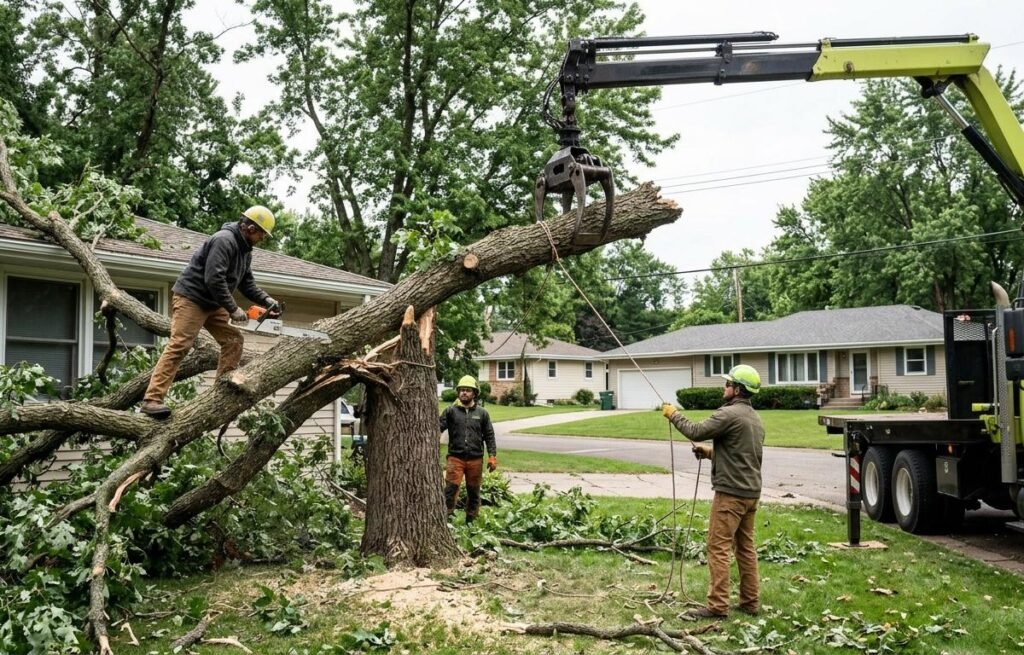
Crane-assisted removal is the answer when a tree can’t be safely climbed or dropped. Think of a large oak leaning over a roof, a trunk pinned against the house, a tree behind a fenced backyard with no truck access, or a lot with pools, gardens and power lines all around. Instead of felling wood into a space that doesn’t exist, a crane takes the weight of each section as it’s cut, lifts it clear and sets it down where it’ll do no harm. That means less risk to your home and less damage to the lawn than dropping or dragging heavy wood. If this sounds like your situation, learn more about crane-assisted tree removal, including crane-assisted tree service in Blaine and crane-assisted tree service in Coon Rapids.
Once the tree is down, you’ll likely be left with a stump. Many homeowners take care of it in the same visit, and our page on tree stump grinding explains what that involves.
Local Permits, Response Times and Getting a Free Estimate in Blaine and Coon Rapids
Permit rules are worth a quick check before any non-emergency removal, and they matter even more if you’re comparing options for storm damage tree removal near me in Blaine or Coon Rapids. Many Twin Cities cities require permits for tree removal in some situations, especially for boulevard trees or trees near public property. Rules differ from one city to the next, and Blaine and Coon Rapids each set their own, so confirm with your city before planning a removal on or near the right-of-way. In an emergency where a tree is threatening your home or blocking access, the immediate priority is making the property safe, and a professional crew can tell you whether any paperwork follows.
On response time, be wary of vague promises. Emergency calls and routine removals run on different standards, and a tree on your roof isn’t the same as a leaning tree that can wait a few days. Ask any company how they triage calls and what to realistically expect for your situation instead of relying on a blanket guarantee. We’re based in the north metro, which keeps us close to Blaine and Coon Rapids, and our emergency crews take urgent storm calls around the clock. You can see the full range of what we do on our services page, and learn about the crew behind it on our about page.
Getting an estimate for storm damage tree removal near me should be simple. Metro Tree & Crane offers free estimates, and the more you can tell us up front, the faster we can plan. Have these ready when you call:
- Where the tree is and what it’s touching (house, garage, fence, vehicle, power line)
- Whether the driveway or an exit is blocked
- Photos taken from a safe distance
- Your insurance carrier and whether you’ve already opened a claim
If you’re looking for tree service in Blaine or tree service in Coon Rapids, you can reach us through our contact page or by phone, and we’ll talk you through next steps even if the damage is still unfolding.
One last point on choosing who to call. Look for a company that’s licensed and insured, can provide a written estimate you can give to your adjuster, has the equipment for hard-to-access trees and will explain the plan before work begins. For a broader look at what storm work involves, see our storm damage cleanup page, and for a national example of how a storm response operation is typically organized, this storm response overview shows the general process. Whatever you choose, put safety first, document before you clean up and let a trained crew handle the cuts that can hurt you.