Finding Tree Trimming Near Me: Directories vs. Local Company Pages
Type "tree trimming near me" into a search bar and two kinds of results come back. The first is directories and lead-generation sites, with star ratings, "free estimate" buttons, 24/7 claims and promised response times. The second is the websites of individual tree companies, which pair a list of services with a phone number and usually a line about certified arborists. Both help, but they answer different questions. Neither tells you what you most need to know: is this company legitimate in Minnesota?
Directories are good for building a shortlist fast. Their weakness is that you often get routed to whichever company paid for the lead, and a high rating says little about insurance, registration or whether a crew will actually show up on your street. Treat a directory as a starting point, not a verdict. Open each company’s own site and hunt for concrete signals: a real local address, the cities it actually serves, photos of finished work, and reviews you can trace back to a source.
A local company page should let you answer a few practical questions before you ever pick up the phone. Does it describe the work you need, such as tree trimming and pruning, removal or storm cleanup? Does it name your city? A company with separate pages for Blaine and Coon Rapids is telling you it works there regularly, not dispatching from an hour away. Check the gallery and the customer reviews for proof of the kind of job you have, whether that’s a routine crown cleanup or a big tree hanging over a roofline.
Search results can also mislead on location. Near-me queries are often localized to wherever the search engine thinks you are, which may not be where your tree is. Search with your city name, then confirm the company’s service area on its own site before you spend time on a call.
Minnesota Registration, Insurance and Credentials to Verify
Before you compare prices, confirm the basics. Every company doing tree care or tree trimming in Minnesota must register with the Minnesota Department of Agriculture. The Tree Care Registry, created under Minn. Stat. Chapter 18G.07, covers any company or person who provides tree care or trimming, or who removes trees, limbs, branches, brush or shrubs for hire. The state explains it on the Tree Care Registry page, and asking a company for its registration before you hire it is completely reasonable.
The Department of Agriculture also publishes a checklist for hiring a tree care company. Beyond registration, it points to a local license where your city requires one, a Sales Tax ID (tree care and trimming are taxable services in Minnesota), and proof of workers’ compensation. Sole proprietorships are exempt from the workers’ comp requirement, so a one-person operation can legitimately lack it. In that case, be extra careful about who is liable if someone gets hurt on your property. A company that applies restricted-use pesticides, such as emerald ash borer treatments, also needs a pesticide applicator license.
Insurance deserves its own step. Ask for a certificate of insurance sent directly from the insurer, not a photocopy handed over on the spot, and confirm it covers both general liability and workers’ compensation. Without adequate coverage, you could be held responsible for property damage or an injury during the job.
Credentials are where homeowners get tangled up. A certified arborist credential from the International Society of Arboriculture is a respected sign of training, and TCIA accreditation is another. But the Department of Agriculture is explicit that none of these accreditations are legal or statutory requirements. They’re voluntary markers of quality, not proof of legitimacy. Count them as a plus once registration and insurance check out, never as a substitute. You can read more about who we are and how we work on our about page.
City Rules and Seasonal Timing for Oak and Ash Trimming
Timing matters as much as who does the work, especially in the north metro. The University of Minnesota Extension reports that the greatest concentrations of oak wilt are found in Sherburne, Anoka, Isanti and northwestern Dakota counties, which puts Blaine and Coon Rapids squarely in the area of concern. The Extension’s oak wilt guidance treats April through July as high risk: don’t wound, prune or fell oaks in oak wilt-prone counties during that stretch. If a wound does happen, treat it immediately with paint or shellac.
In some cities this isn’t just advice; it’s law. Coon Rapids makes it unlawful to prune or trim any oak tree from April 1 to June 30, and owners with an infected tree get 20 days from receipt of notice to have it taken down and removed. The city lays out its rules on its oak wilt control page. Other sources use a wider window running through July, so the safest move is to check your own city’s dates rather than assume one number fits everywhere. A company that offers to trim your oak in May without mentioning any of this is a warning sign.
Ash trees run on a different clock. Emerald ash borer has been detected in Anoka County, and removal of infested ash is best done during the dormant season, October 1 to May 1. Anoka Municipal Utility notes that putting off removal of an infested ash tends to raise the cost, because a heavily infested ash is more dangerous to take down. The conservation district’s guide to managing emerald ash borer and oak wilt in Anoka County is a useful companion read.
One more caution on rules: some Minnesota cities require their own tree contractor license on top of state registration. We didn’t find a specific tree trimmer license rule for Blaine or Coon Rapids, so call your city hall or check its website before you hire. A good company will already know the answer and won’t mind that you asked.
Comparing Quotes and Questions to Ask Before You Hire
Get at least two or three written quotes, and make sure each one describes the same job. A fair comparison needs the same scope: which trees, how much canopy is coming off, whether debris is hauled away or left behind, and whether stump work is included. A low bid that quietly skips cleanup isn’t actually lower. Be wary of price figures you see online. Most published averages are national, and we have no verified Minnesota trimming prices to quote, so treat your local written estimates as the real benchmark.
A handful of questions separates careful companies from careless ones:
- Are you registered with the Minnesota Department of Agriculture, and can I see proof of insurance from your insurer?
- Do you hold any local license my city requires?
- Who will be on site, and is a certified arborist supervising the work or only selling it?
- How do you prune, and will you avoid topping? Reputable arborists avoid topping, and a recommendation to top a tree is a red flag.
- If the tree is an oak, how will you handle the April-to-July restriction?
- What equipment will you use, and will you need access to the back yard or a crane?
Watch how a company answers, not only what it says. Clear, unhurried answers and a written estimate are good signs. Pressure to sign today, a demand for full payment up front, or door-to-door offers after a storm are not. Whatever the job, a free estimate should be exactly that, with no obligation and no charge for the visit.
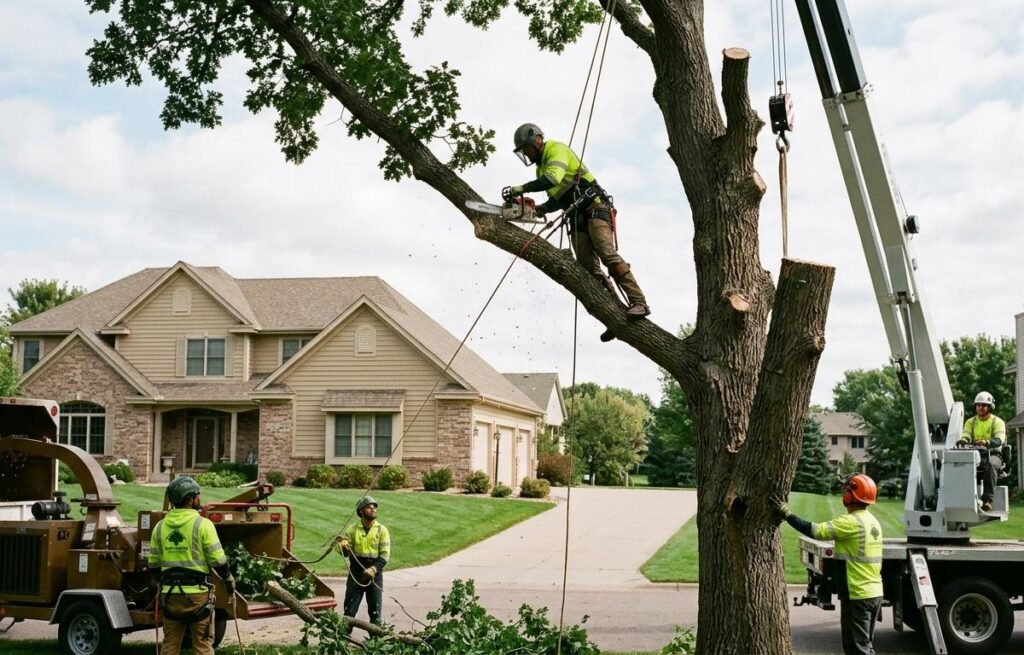
For tricky jobs, like large trees close to a house, power lines or fences, ask whether the company offers crane-assisted removal instead of climbing everything. A crane can lower sections safely over structures where rigging by hand would risk damage. If you need removal rather than trimming, our overview of tree removal explains what the work involves.
Storm and Emergency Tree Work: What 24/7 Service Should Mean
When a limb is on your roof or a trunk is blocking your driveway, a search for "tree trimming near me" turns into a scramble for anyone who’ll answer the phone. That urgency is exactly what unscrupulous operators exploit. Anyone can put "24/7" on a website, so it’s worth knowing what it should actually mean.
Real emergency service means a person answers at any hour, gives you an honest arrival window, and can dispatch a crew with the right equipment for the situation. It also means the same standards still apply: registration, insurance and a clear scope of work. A genuine emergency company won’t skip those steps just because the situation is stressful, and it won’t ask you to sign a blank contract in the dark. If someone shows up uninvited after a storm and offers to start right now for cash, treat that as a reason to slow down, not speed up.
Safety comes first. If a tree or limb is touching or near a power line, stay away and call your utility; don’t let anyone start cutting until the line is dealt with. Keep people and pets clear of leaning or hanging trees. For damage that’s stable and not an immediate hazard, take photos for your records before work begins.
Metro Tree & Crane provides round-the-clock help across the Twin Cities north metro. You can read about our emergency tree services, including local pages for Blaine and Coon Rapids, and about our storm damage cleanup. With more than 30 years of experience, a licensed and insured crew and the cranes to handle hard-to-reach trees, our goal is to make a stressful situation safer and simpler. When you’re ready, contact us for a free estimate, and use the same vetting questions above on any company you consider, including ours.