Typical Tree Removal Cost Ranges and What They Mean
How much will this cost? The honest answer is that tree removal cost depends on the tree, the yard and the work involved. Treat any national average as a rough starting point, not a promise. A small ornamental tree in an open front yard is a very different job from a tall, leaning oak hanging over a roof. Online pricing guides disagree with each other, and most are published by lead-generation sites rather than independent statistics bodies, so read their numbers as ballparks.
The clearest published figures are for the stump portion of the job. One national guide puts the average stump-grinding job at $272, with a typical range of $131 to $438. Another puts professional grinding at about $320, with a range of $150 to $500. Quoted national averages for stump work run anywhere from about $250 to $450, depending on who you ask. That spread is the first lesson. When sources differ that much on a fairly simple service, quotes for full tree removal will vary even more.
What does that mean for your budget? Felling and removing the tree itself is generally priced separately from the stump. Size, height, location and how hard the tree is to reach drive that price. We won’t invent a per-tree number here, because a fair one only comes from someone looking at your tree. What you can do is learn the pieces a contractor adds up, so when a quote arrives you can see where the money goes and judge whether it’s reasonable.
Think of a quote as three layers: the removal itself, the cleanup and haul-away, and any stump work. Some companies bundle all three into one number. Others itemize them. Neither approach is wrong, but you need to know which one you’re being offered before you compare prices.
What Drives the Price: Size, Height, Access and Surcharges
Four things move the price more than anything else: how big the tree is, how tall it is, what surrounds it, and how hard the wood is.
Size and height. A taller, wider tree means more time, more rigging and more material to cut up and carry off. Height also adds risk. The closer a tall tree stands to a house, garage, fence or power line, the more carefully each section has to be controlled on the way down, and that takes time.
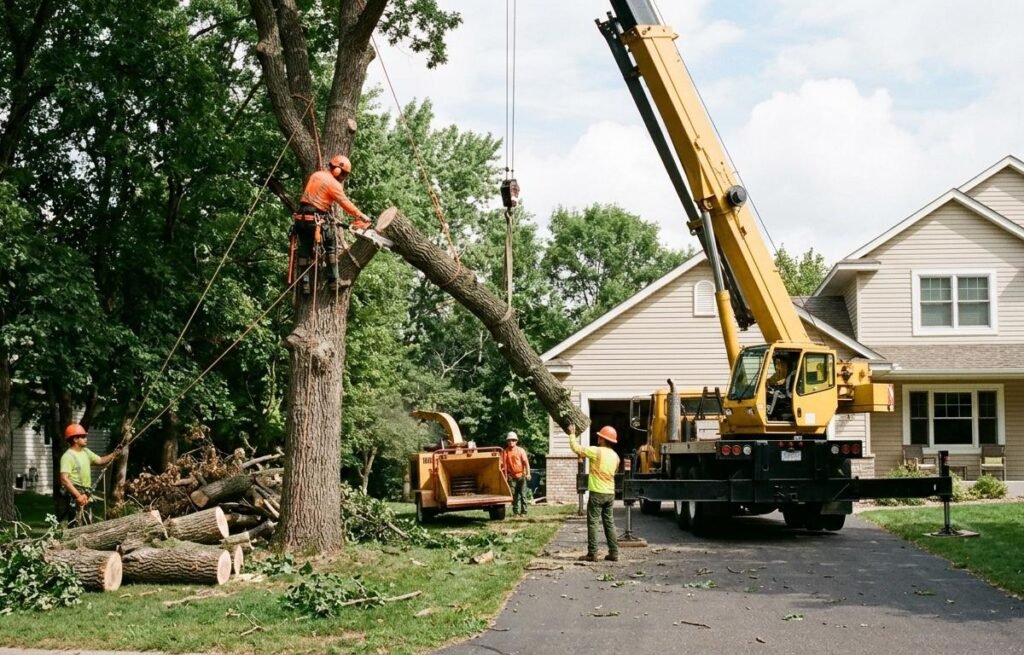
Access. A tree in a backyard behind a locked gate, in a narrow side yard, or on a lot where equipment can’t reach is harder and slower to work than one beside the driveway. When trucks and chippers can’t get close, crews haul debris by hand. In tight or crowded spots, a crane can be the safest option, because it lifts sections out over the roof instead of dropping them near it. Crane work adds equipment cost, but it can also lower the risk of property damage. If structures hem in your tree, ask whether crane-assisted tree removal makes sense for your site.
Wood and condition. Hardwoods like oak are denser and take longer to cut and grind than softwoods like pine. Stump guides reflect this: grinding is commonly priced at $2 to $5 per inch of diameter with a minimum around $100, and hardwoods often carry a surcharge on top. A dead or storm-damaged tree can also cost more, because it’s less predictable to cut.
Surcharges and add-ons. Watch for the items that quietly raise a quote: rocks or buried debris near a stump, haul-away of logs and brush, and emergency or after-hours rates. One national guide prices debris removal separately, at around $2 to $3 per diameter inch. Measure carefully, too. Stump diameter is taken at the widest point, including the root flare, not the neat circle on top of the cut. A 24-inch trunk can flare much wider at ground level, and that changes the number.
Our own tree removal work is quoted on exactly these factors, which is why we look at the tree before giving a price.
Stump Grinding vs. Stump Removal: Price Gap and How to Compare
Once the tree is down, you have a stump and a choice. Grinding uses a machine to chip the stump into mulch, usually down below ground level. Removal pulls out the entire stump and its root system. They aren’t the same service, and the price gap is real.
Grinding is the cheaper and more common option. One national guide places grinding at roughly $170 to $500 and says full removal can run $100 to $200 more. Other guides put removal at anywhere from about two to five times the cost of grinding. Estimates vary widely, so the safe conclusion is that removal costs meaningfully more. A first stump often costs more than later ones, and many companies discount additional stumps on the same visit, so ask if you have several.
The right choice depends on what you plan to do with the spot. If you just want the lawn back, grinding is usually enough. If you plan to build there or replant a new tree in the same location, removal gives you usable space, while grinding leaves roots underground that take years to decompose. Some species can also send up shoots from remaining roots, so ask about regrowth if that worries you.
Depth is the detail that trips up comparisons. Local companies quote grinding depths anywhere from about 4 inches to 12 inches or more. A shallow grind that works for grass won’t do for a garden bed or a replanted tree. Two quotes at similar prices can describe very different work, so always ask how deep the crew will grind before you compare.
A word on renting a grinder yourself: rental runs roughly $90 to $400 per day depending on the machine, and small units only handle smaller stumps. For a single stump, the savings over hiring a professional are usually small, and you take on the safety risk and the utility-locate responsibility described below.
What a Written Quote Should Include and Who Calls 811
A good written quote removes guesswork. Before you sign, make sure it spells out, in plain terms:
- Exactly which tree or trees are being removed, and whether stump work is included
- Stump diameter and the depth of grinding, if grinding is part of the job
- Whether cleanup and haul-away of logs, brush and wood chips are included or priced separately
- Whether backfill or topsoil for the grinding hole is included
- Proof of insurance and licensing
- Who is responsible for calling for utility locates, and when
That last point matters more than most homeowners expect. Minnesota law (Chapter 216D) requires calling Gopher State One Call at 811 before digging with power equipment, with at least 48 hours’ notice, excluding the day of the request, weekends and holidays. Municipal sites list stump grinding and removal as a project type that needs a locate request. You can read how the process works through Gopher State One Call, and several cities explain it for residents, including this call before you dig page.
In general, the person doing the work is responsible for placing the request, so a professional contractor should handle it. Confirm that in writing rather than assuming. The 48-hour lead time can also affect when work can start, so a stump job isn’t always same-day.
There’s one more catch. Gopher State One Call marks public utility lines. It does not locate private ones, such as sprinkler systems and private gas, electric or cable lines. Those are your responsibility. Tell your contractor where your irrigation lines and any buried private lines run, or hire a private locator, so a grinder doesn’t hit them.
Twin Cities North Metro Pricing, Storm Work and Free Estimates
We’ll be straightforward: there is no reliable, independent price table for the Twin Cities north metro, and we’d rather say so than invent one. Local rates vary with the season, how busy crews are, the species and size of the tree, and how tough the access is. In places like Blaine and Coon Rapids, many lots have mature trees close to homes and power lines, which is exactly the kind of setup that raises both difficulty and price. Expect variation from one quote to the next, and judge quotes on what they include, not only on the bottom line.
Storm work is its own category. After high winds, a fallen or hanging tree is urgent, and emergency, after-hours or same-day response usually costs more than a scheduled job because crews and equipment have to be pulled in fast. If a tree is on a structure, blocking a driveway, or tangled with lines, don’t try to handle it yourself. Our emergency tree services are available around the clock, and we cover specific areas such as emergency tree service in Blaine, MN and emergency tree service in Coon Rapids, MN. For wider damage, our storm damage cleanup work covers the aftermath. Never approach a tree that’s touching a power line. Call the utility first.
For non-emergency jobs, the best way to get a number you can trust is a free, on-site estimate. A contractor who looks at the tree, measures the stump, checks access and asks about utilities can give you a quote that reflects your property, not a national average. Metro Tree & Crane is licensed and insured, with more than 30 years of experience across the north metro. You can learn more about our team or see the full range of services we offer.
When you compare estimates, line them up on the same terms: what’s being removed, grinding depth, haul-away, backfill and insurance. When you’re ready, contact us to schedule a free estimate for your property, and ask any pricing questions before you commit.